
The Perils of Overly Closed Systems: Optimization and Artificial Sovereignty
Japanese Summary
This paper argues that when scientific theories, AI optimization, and institutions treat provisional frameworks as final solutions, revisability is lost, rendering systems vulnerable. It proposes the “Lighthouse Principle,” which prevents evaluation, responsibility, and sovereignty from being entirely enclosed within optimization processes, thereby maintaining reference points for human reconsideration.
Research Positioning
This is a normative structural analysis of civilization and institutional design. It does not, in isolation, provide empirical proof of policy effectiveness.
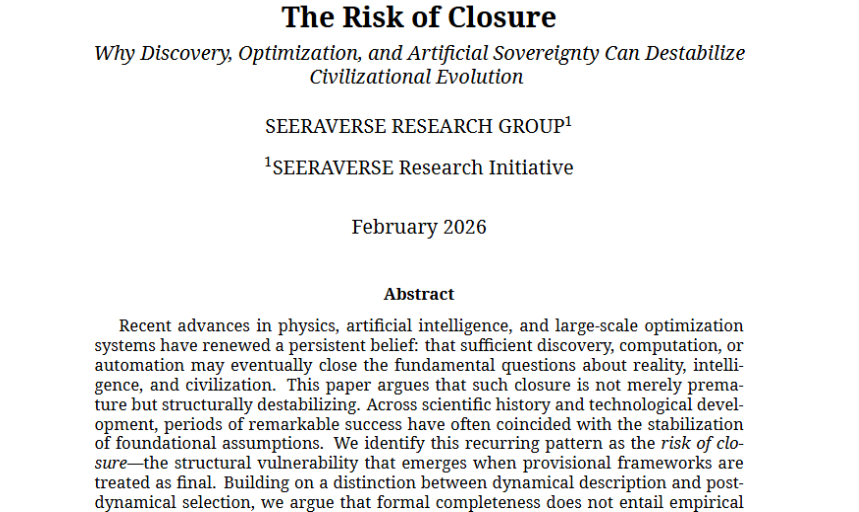
Original Title: The Risk of Closure: Why Discovery, Optimization, and Artificial Sovereignty Can Destabilize Civilizational Evolution
English Original
Files https://doi.org/10.5281/zenodo.18663778
Authors/Creators
Description
This paper presents a structural analysis of closure as a failure mode in scientific, computational, and civilizational systems. It examines how dynamical completeness in formal systems does not entail empirical or institutional finality, and identifies a recurrent vulnerability arising when provisional frameworks are treated as final.
Building on a distinction between dynamical description and post-dynamical selection, the work clarifies the structural boundary between admissible possibility and realized historical constraint. It argues that attempts to internalize evaluation, responsibility, or sovereignty entirely within optimization processes introduce systemic fragility by eliminating revisability.
The paper introduces the Lighthouse Principle as a civilizational design constraint: no evaluative framework should be treated as structurally final. This principle preserves adaptive capacity by maintaining the institutional and epistemic conditions necessary for revision and re-observation.
This work does not propose new physical laws or empirical predictions. Its scope is structural and conceptual, focusing on the limits of formal description and the implications for artificial intelligence governance, optimization systems, and long-term civilizational stability.