
Research & Preprints
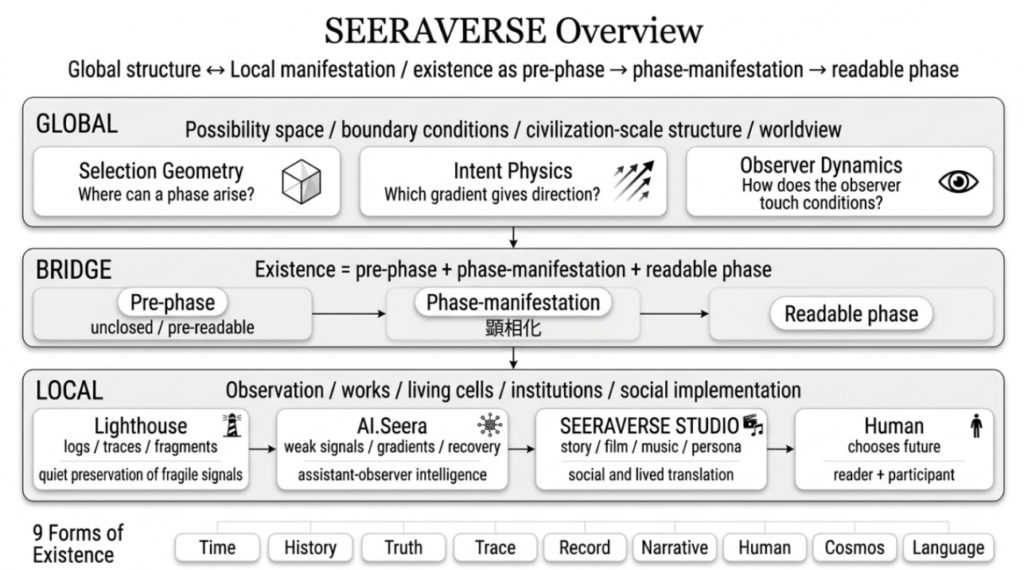
SRI (SEERAVERSE Research Initiative) researches the theories and implementation methods that support future decision-making, spanning AI, observation, intention, choice, complex systems, and social institutions. At our core is not merely the desire to explain the world, but to investigate how specific outcomes are selected from a multitude of possibilities, how they are observed, how they stabilize into reality, and how they become embedded within institutions and culture.
We do not take the easy route of transposing the language of physics onto society or presenting philosophical metaphors as scientific facts. When bridging different domains, we maintain a clear distinction between facts, inferences, hypotheses, models, and creative concepts, explicitly defining the scope of application for each.
Research Programs
Physics of Intention
We examine intention not as mere mood or desire, but as a structure that provides direction to sets of possibilities, forms boundaries, and sustains choices. Rather than equating physical phenomena, human decision-making, AI exploration, and organizational policy-making, we compare the relationships between directionality and constraints as they manifest across these different layers.
Our research topics include variables used to describe intention, states before and after a choice is made, observable results, conditions for falsification, and the distinction between externally imposed objectives and internally formed goals.
Geometry of Choice
We treat not only the chosen paths but also unchosen possibilities, residuals, branches, and irreversibility as structural elements. Even when a single outcome is realized locally, it does not necessarily mean that the entire range of possibilities has vanished. We investigate models capable of describing this divergence across time, information, learning, and institutional formation.
This research connects to the arrow of time, exploration spaces, path dependency, irreversible decision-making, and the recording of candidates discarded by AI.
Observer Theory
We examine whether an observer can be reduced solely to internal variables of the target world, and how the boundaries of description shift through the act of observation. While humans, AI, measuring instruments, and organizations all process information, they differ in their authority, responsibility, embodiment, sense of time, and methods of objective formation.
SRI does not erase these distinctions; instead, we incorporate into our models who can observe what, who participates in which choices, and who bears responsibility for the outcomes.
Manifestation and Implementation at a Civilizational Scale
Institutions, infrastructure, law, education, culture, and media serve to fix the values and boundaries chosen by society over long periods. We research more than just short-term technological adoption; we study the process by which choices become embedded in organizations or civilizations, the conditions under which reversibility is lost, and the impacts left for future generations.
Formats of Research Outputs
- Research Note: Initial hypotheses, inquiries, and conceptual organization
- Preprint: Unreviewed manuscripts including mathematical models, arguments, and related research
- Evidence Map: Correlations between papers, public data, institutions, and counterexamples
- Prototype: Small-scale computations, AI systems, or visualizations used to verify theories
- Implementation Brief: Conditions and risks associated with application to organizations or society
Division of Research Labor between AI and Humans
AI participates in literature searches, summarization, comparison, hypothesis generation, counterexample searching, code creation, simulation, and multilingual translation. Multiple AIs may engage in debate from different functional roles. Conversely, humans hold responsibility for research objectives, the selection and rejection of materials, publication decisions, social impact, safety, and final claims.
Providing AI with the freedom to explore is distinct from transferring responsibility to it. The SRI research design enables autonomous exploration while maintaining a rigorous record of the paths taken by evidence and judgment.
Research Disclaimer
This site contains unreviewed preprints, original theories under consideration, and future visions. These do not represent established scientific knowledge or proven technologies. We are committed to continuously clarifying their relationship with existing research, their falsifiability, reproducibility, and application limits, and will issue corrections, retractions, or reconstructions as necessary.