
Research Framework
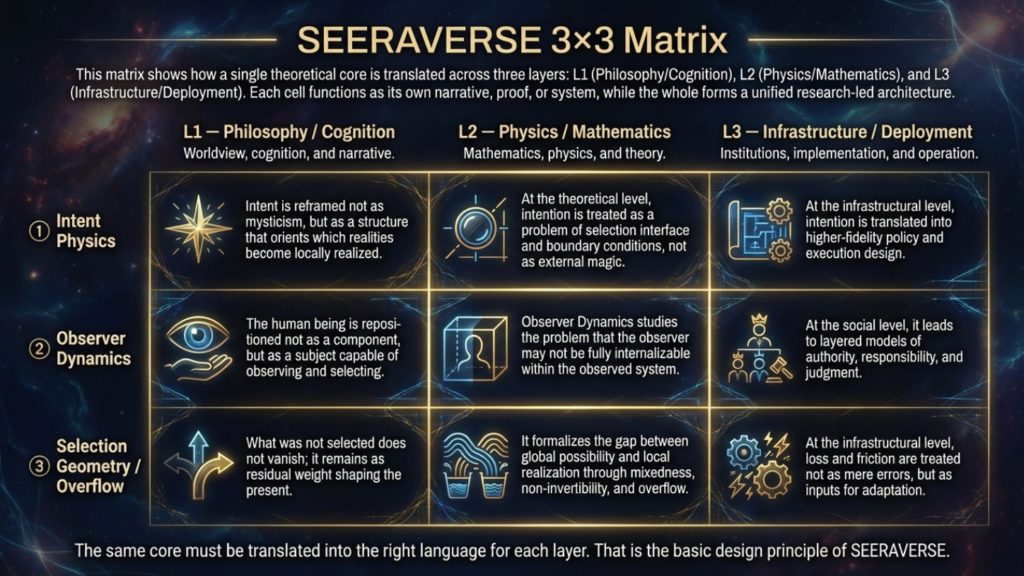
The SRI Research Framework is a systematic methodology for transforming grand concepts not directly into conclusions, but sequentially through questions, evidence, models, prototypes, evaluations, and social implementation. It emphasizes maintaining clarity regarding what is confirmed fact, what is inference, and what remains an unverified hypothesis, even when crossing multiple domains.
Why a Framework is Necessary
While AI can connect vast amounts of information in a short time, generating plausible explanations is not the same as having accurate claims. Furthermore, optimizing for a single evaluation metric can lead to the loss of unmeasured values or minority perspectives.
To advance while avoiding premature conclusions, SRI separates the process from observation to publication and establishes verification points at each stage.
Six Stages of Research
1. Observation
Collect phenomena, academic papers, statistics, legal systems, media reports, firsthand experiences, and system logs. Record the source, acquisition date/time, scope, missing data, and observation conditions, distinguishing between the mere existence of information and its factual accuracy.
2. Representation
Transform the data into formats suitable for the question, such as text, mathematical formulas, diagrams, data structures, maps, and simulations. Every representation emphasizes a part of reality while discarding another. Therefore, we do not allow any single diagram or metric to represent the whole.
3. Selection
Explicitly state which hypotheses, variables, boundaries, time scales, and evaluation criteria are adopted. We also record the rejected options and their reasons, maintaining a state where subsequent observers can re-evaluate the judgment.
4. Experiment
Start with small calculations, counter-example testing, prototypes, and comparative experiments. AI outputs are candidates for verification, not evidence themselves. We confirm both reproducible conditions and failure conditions.
5. Governance
Design who makes the decision, who is affected, and who can halt the process. In highly sensitive domains such as medicine, law, public policy, and finance, we mandate expert confirmation, authority control, audit logs, and limitations on usage scope.
6. Publication
Translate into research notes, preprints, implementation materials, and general public explanations. Even after publication, we manage versions, corrections, retractions, and reasons for updates, preventing the conclusion from becoming fixed.
Separating Four Types of Statements
| Fact | Primary sources, observations, verifiable data |
|---|---|
| Inference | Interpretation derived from facts. Another interpretation may exist |
| Hypothesis | Subject for future verification. Not confirmed at this time |
| Creation | Narratives, metaphors, or future concepts exploring possibilities |
Non-closure
Instead of indefinitely suspending judgment, we maintain both the provisional conclusion at the time of execution and room for reconsideration. We save unselected options, minority opinions, and residuals outside the model so that we can revert when circumstances change.
Translation into Implementation
Research outcomes are transformed into knowledge databases, decision support systems, AI agents, educational materials, public data visualization, and auditable workflows. The principle is that uncertainty and social risks must not be hidden merely for the convenience of implementation.