Observer Dynamics and Spectral Selection
Summary
We distinguish between the layer that generates possibilities, the layer representing probability distributions, and the layer where outcomes are realized, defining the observer as the boundary condition that enables realization. Since selection cannot be represented as a reversible map within the same state space, we attempt to explain the structure of time and observation.
Research Context
The presented formulation and proofs are unreviewed. This work does not present established conclusions regarding the entirety of quantum theory, but rather proposes a minimal structure suitable for discussion.
Original Title: Observer Dynamics and Spectral Selection: A Structural Framework for Generative–Stochastic–Manifest Realization
English Original
Files https://doi.org/10.5281/zenodo.18735543
Authors/Creators
Description
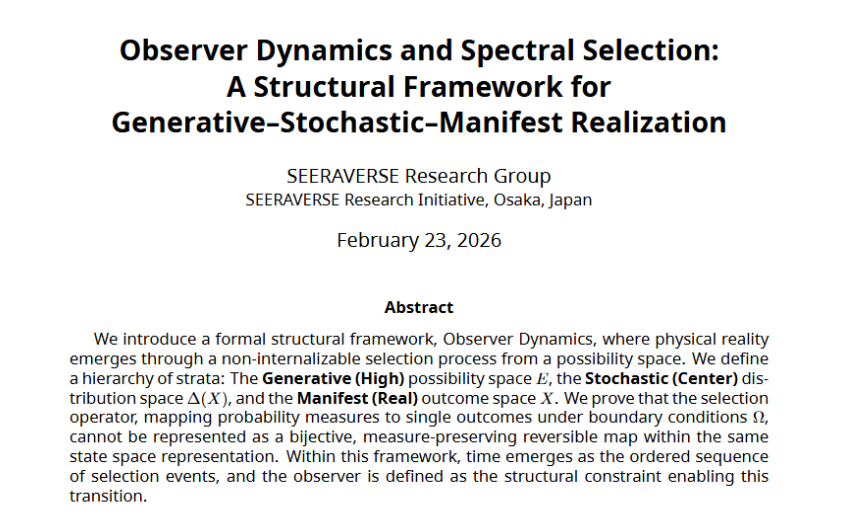
This paper introduces Observer Dynamics, a structural framework in which reality emerges through a non-internalizable selection process acting upon a hierarchy of strata: Generative (possibility space), Stochastic (distributional space), and Manifest (realized outcome space).
We formally define possibility space E, measurement mapping M: E → Δ(X), and selection operator Sel: Δ(X) × Ω → X under boundary conditions Ω. We prove that selection cannot be represented as a bijective, measure-preserving reversible map acting within the same state space representation.
Within this framework, time emerges as the ordered sequence of selection events, and observers are defined as structural boundary conditions enabling realization.
This work establishes a minimal structural reference formulation for selection, observer boundary conditions, and time emergence, independent of specific physical or dimensional assumptions.