
Hilbert Space Model for a Coupled Universe
Japanese Explanation
We consider a Hamiltonian coupled to the observable region and a finite-dimensional auxiliary sector, examining the relationship between self-adjoint extensions, mirror symmetry, and spectral conditions. Furthermore, we propose a relationship between the vacuum energy condition (using the analytic continuation of the zeta function) and the auxiliary dimension.
Positioning of this Research
This is not a result that determines the number of dimensions or the physical structure of the universe. It is an unreviewed model connecting multiple mathematical concepts, and verification of the assumptions’ validity and physical interpretation is required.
Original Title: A Hilbert Space Model for a Coupled Universe: Self-Adjoint Extension, Mirror Symmetry, and Dimensional Constraint
English Original
Files https://doi.org/10.5281/zenodo.17549295
Authors/Creators
Description
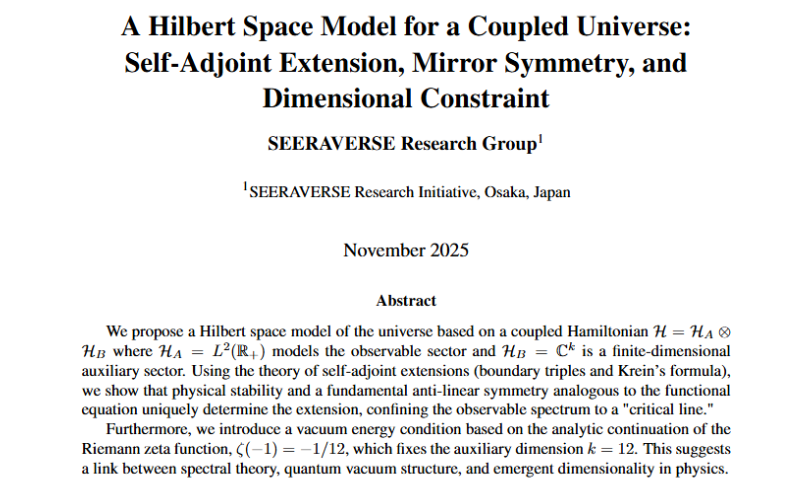
We propose a Hilbert space model of the universe based on a coupled Hamiltonian H = HA ⊗
HB where HA = L2(R+) models the observable sector and HB = Ck is a finite-dimensional
auxiliary sector. Using the theory of self-adjoint extensions (boundary triples and Krein’s formula),
we show that physical stability and a fundamental anti-linear symmetry analogous to the functional
equation uniquely determine the extension, confining the observable spectrum to a “critical line.”
Furthermore, we introduce a vacuum energy condition based on the analytic continuation of the
Riemann zeta function, ζ(−1) = −1/12, which fixes the auxiliary dimension k = 12. This suggests
a link between spectral theory, quantum vacuum structure, and emergent dimensionality in physics.