
The SEERAVERSE RH Program: A Meta-Methodology for Auditable Proof Search
The SEERAVERSE RH Program: A Meta-Methodology for Auditable Proof Search
This paper presents a “meta-methodology” designed to manage the entire process of searching for long and complex mathematical proofs, such as those related to the Riemann Hypothesis (RH). The goal is not merely to present a final conclusion, but to treat the search process itself as an auditable, reproducible, and reusable research asset. This aims to build an architecture that systematizes not only the discovery of mathematical truth but also the thought pathways, hypothesis generation, counter-evidence, and knowledge accumulation processes leading up to that truth, enabling human and AI collaboration in the exploration.
Problem Formulation: Lack of Auditability in Long Proof Searches
Modern advanced mathematical proofs often rely on vast numbers of equivalent transformations, complex assumptions, and deep intuition. In such long-term iterative search processes, conventional mathematical approaches and computational verification methods face several challenges:
- Loss of Path: Diverse logical branches attempted during the proof process, or knowledge derived from failed hypotheses, are easily lost and difficult to reuse.
- Redundant Exploration: Repeated searches within the same logical space or concerning equivalent questions occur repeatedly, diminishing efficiency.
- Ambiguity of Causality: The causal relationship—which inference or assumption contributed to the final conclusion, or which branch failed decisively—is not clearly tracked.
- Ambiguity of Finite Verification: Even when using finite verification means like interval arithmetic or arbitrary precision calculation, there is a lack of meta-level evaluation criteria regarding how those results guarantee the reliability of the entire search space.
These challenges suggest the necessity of re-framing proof searching not as a mere chain of inferences, but as a dynamic network of knowledge and hypotheses.
Proposed Search Architecture
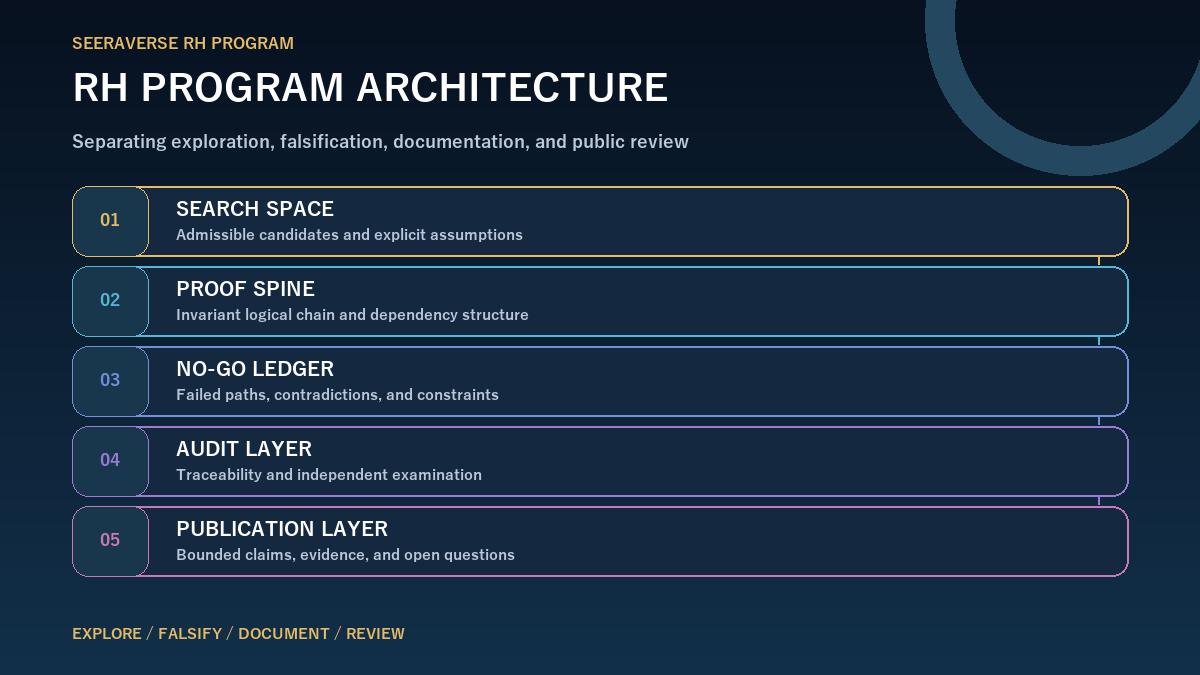
This meta-methodology proposes a search architecture composed of the following core components to make long-term exploration auditable and reproducible. This architecture aims to separate the “skeleton” and the “history” of mathematical arguments, thereby structuring knowledge management.
Invariant Proof Spine
Defines the logical and conceptual skeleton that remains unchanged throughout the research. This represents the fundamental premises and structural conclusions regarding the ultimate goal or essential mathematical object, which must remain fixed regardless of how complex the exploration becomes. All search paths must proceed along this invariant spine.
One-live-lock / one-next-move
At each search step, it clearly identifies a single primary logical obstacle (the “lock”) currently faced, and a specific action to be verified next (the “next move”). This focuses the exploration and prevents inefficient branching.
No-Go Ledger
Records paths that have stalled or become invalid due to failed logical branches or counter-evidence. This ledger is not merely an error log; it functions as a constraint condition used to prevent repeating the same search, treating it as “negative knowledge.” By doing this, it eliminates redundancy within the search space and allows for resource allocation toward new directions.
Equivalence-preserving Compression
Tracks whether alternative formulations or equivalent transformations retain the essential information of the problem without obscuring it. It quantitatively evaluates whether the proof obligation has been substantially reduced and compresses inefficient redundancies.
GCD/LCM analysis
Separates and analyzes the smallest common logical core (Greatest Common Divisor, GCD) shared among multiple different arguments or hypothesis groups, and the refined conditions required to achieve them (Least Common Multiple, LCM). This clearly distinguishes between abstract structure and specific numerical or conceptual details, aggregating only necessary information.
Truth by Shadow
Establishes a policy of using auditable “shadows” or “projections” to verify the essence of objects or complex structures that are difficult to handle directly. This is an approach for confirming partial truths through external observation before reaching a complete proof.
The Boundary Between Mathematics and Computational Verification
This methodology clearly separates qualitative mathematical arguments (conceptual insights) from effective constant evaluations and machine-assisted finite verification (computation). Specifically, when using computational techniques such as interval arithmetic, the Krawczyk method, or arbitrary precision ball operations, it is crucial to treat their results not vaguely as empirical evidence, but as “finite gates” within the search space. These computational tools do not verify the truth of the final proof itself; rather, they are means to verify whether a specific logical step has been satisfied.
The Role of Finite Verification
Finite verification methods provide a “finite certification”—determining whether a hypothesis lies within an acceptable range—during the search process. This certification does not stop the exploration; rather, it functions as a constraint condition for moving to the next step.
Human-AI Collaboration: A System for Knowledge Generation and Verification
This architecture assumes an environment where humans and AI collaborate by taking on different roles. Humans bear the high-level conceptual judgment and ultimate responsibility concerning the “Invariant proof spine” and “Truth by Shadow.” Meanwhile, the AI is responsible for generating auditable history and optimizing efficiency, such as recording entries in the “No-Go ledger,” comprehensive exploration of the search space, automatic generation of equivalent transformations, and identifying structural relationships based on “GCD/LCM analysis.”
- AI Role: Candidate hypothesis generation, automated counter-evidence path searching, recording failed branches, compression via equivalent transformations.
- Human Role: Defining the logical skeleton (Invariant proof spine), making meta-level judgments (which failures to retain as negative knowledge), and interpreting the final truth and accepting responsibility for it.
The AI’s output is not treated as a conclusion, but is converted into an auditable search history, thereby guaranteeing its reliability. This allows the AI to function as a tool that enhances exploration efficiency, while the human maintains accountability for the entire process.
Scope of Application and Limitations
Applicable Scope
This meta-methodology is applicable not only to specific proof problems like the Riemann Hypothesis but also to any other mathematical or theoretical research where the search space is large, equivalent transformations are numerous, and loss of intermediate steps or redundant exploration is likely. Furthermore, it functions as a knowledge management framework in all research environments where humans and AI jointly generate hypotheses, counter-evidence, record data, and verify results.
Limitations and Outstanding Issues
This methodology provides a framework for making the search process auditable; it does not prove the mathematical conclusion itself. Therefore, its scope is strictly limited to “structuring the exploration.” The following points are identified as outstanding issues:
- Meta-level Criteria: Establishing objective criteria for judging which failed branches should be retained as negative information (setting the threshold for recording in the No-Go ledger).
- Definition of Truth: Introducing methods for non-standard logical leaps or intuition necessary to rationally converge from the search history toward a final “truth.”
- Scope of AI Responsibility: Strictly defining the boundary between auditable results and human responsibility, and constructing legal and ethical frameworks for social implementation.
Treating Search Records as Research Assets
What is important about this methodology is that it does not consider only a completed proof as an achievement. In long-term exploration, knowing why one path failed, or what other problem arises when assuming a different hypothesis, or at which stage computational confirmation is required, all serve as information supporting subsequent judgments. By saving failed branches along with their reasons, future repetition of the same path can be avoided. Furthermore, when new tools or perspectives are gained, this history provides grounds for re-evaluating previously closed branches.
By “auditable” here, we do not mean replacing research with a mechanical checklist. It refers to a state where third parties or future researchers can track which claim follows from definitions, where auxiliary hypotheses were used, which parts remain unproven, and what range of truth the computational results guarantee. This framework is designed not to exclude intuition or insightful leaps, but to record where such insights acted within the proof obligation.
Distinguishing Equivalent Reformulations from Substantive Progress
In difficult problems, it is possible to express the same content using different notations or terminology from different fields. Re-formulation can be an entry point for introducing new tools, but sometimes merely changing the expression leaves the unresolved parts intact. What this Preprint emphasizes is not the novelty of the reformulation, but confirming whether the remaining proof obligation has genuinely shrunk.
Therefore, we record what is preserved and what additional conditions are required before and after a transformation, and which points remain unsolved. By separating the logical core common to multiple paths from the additional refinement necessary only for individual paths, we improve visibility into the exploration. This organization does not automatically guarantee the correctness of the proof, but it clarifies the criteria for progress, reducing the risk of repeating the same problem under a different name.
Where to Place Finite Verification
Interval arithmetic, Krawczyk method, and arbitrary precision ball operations are not magic that prove infinite mathematical statements directly. They are means to confirm conditions, including rounding errors, after the problem has been reduced to explicit finite conditions through analytical arguments. Therefore, before using finite verification, the object of inspection, the interval, the precision, the error bound, the recalculation procedure, and the logic connecting the finite confirmation back to the overall claim must be explicitly stated.
This Preprint incorporates the principle of not blurring this boundary into its methodology. It records qualitative mathematics, explicit derivation of constants, and machine-based finite verification as separate layers, ensuring that computational results alone are not called a proof. What this paper shows is not an audited RH proof, but the management principles for bringing research close to such strict finite gates.
Checkpoints When Reading This Document
- Which parts constitute general research methodology and which parts are specific examples using RH?
- Are the invariant logical skeleton and the updated working hypotheses separated?
- Are failed branches saved not only with conclusions but also with reasons?
- After re-formulation, has the remaining proof obligation truly shrunk?
- Is the range guaranteed by numerical computation distinguished from the scope covered by analytical arguments?
These are checkpoints for evaluating the effectiveness of this methodology and do not imply that the methodology itself is complete. Future work requires operational verification on actual search histories: determining which units should be recorded, how to compare records between different researchers or AI systems, and how to audit the ledger update rules.
Bibliography
Original Title: SEERAVERSE RH Program: A Meta-Methodology for Auditable Proof Search Around the Riemann Hypothesis
Document Type: Preprint
Publication Date: October 2, 2026
Publisher: SEERAVERSE Research Group
Included Languages: Japanese / English
DOI: 10.5281/zenodo.23101473
The Japanese and English PDF versions can be found on the Zenodo record page.