
Consciousness as the ‘Observer-Side Interface of Realization’
Japanese Summary
This paper avoids defining consciousness as either a mystical force that collapses quantum states from the outside or a mere byproduct of local computation; instead, it positions consciousness as the boundary where possibilities are transformed into local experience. It proposes a structural vocabulary for connecting first-person experience with the realization of the world.
Research Context
This work does not constitute a complete neuroscientific theory, nor does it make empirical claims that consciousness directly causes physical phenomena.
Original Title: Consciousness and Observer-Experience as the Observer-Side Interface of Realization
English Original
Files https://doi.org/10.5281/zenodo.19118983
Authors/Creators
Description
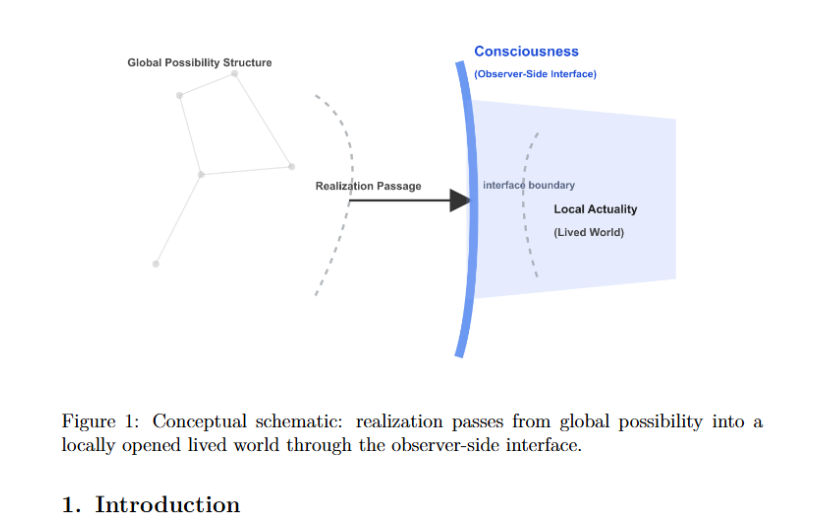
This paper examines how consciousness may be situated within the broader framework of observer-dependent realization developed in the preceding papers. Rather than treating consciousness as either a detachable metaphysical substance or a purely local computational byproduct, it proposes that consciousness may be understood as the observer-side interface through which the directional structure of realization becomes lived experience.
The paper does not argue that mind externally causes collapse, nor does it claim to provide a complete neuroscientific theory of consciousness. Its aim is narrower and more structural: to clarify how first-person experience may arise at the boundary where global possibility is locally realized without full closure. On this view, consciousness is neither a second physics nor an illusion, but the interface at which a realized process becomes available as lived experience.
Within this perspective, first-person irreducibility is interpreted not as a failure of explanation in principle, but as the lived sign of non-closure. Experience is not added to an already completed world from outside; rather, it marks the way in which reality formation becomes available from the observer side. The paper also considers implications for artificial systems, shared reality, and observer networks, while explicitly limiting its claims: it does not prove that no artificial system could ever instantiate observer-side realization, but argues that formal transformability alone does not settle the question.
This paper is the sixth in the Selection Geometry / Intent Physics sequence. Papers I–V asked how reality forms. Paper VI asks how that formation becomes lived. It therefore serves as a bridge between the structural account of realization and the later account of synchronization, shared reality, and civilization-scale organization developed in subsequent work.