
Civilization as a Program for Sequencing Realization
Japanese Summary
This paper explores civilization not merely as an accumulation of tools and institutions, but as a process that stabilizes, transmits, and revises structures realized by multiple observers across generations, institutions, and technologies. It presents civilization not as a closed, completed entity, but as an open structure that enables continuity and re-selection.
Research Positioning
This is a unique structural hypothesis from SRI that bridges civilization theory with observer-dependent processes of realization. It is not intended to be presented as an established general theory within history or the social sciences.
Original Title: Civilization as the Programmatic Sequencing of Realization
English Original
Files https://doi.org/10.5281/zenodo.19123343
Authors/Creators
Description
Civilization as the Programmatic Sequencing of Realization examines how civilization may be understood once observer-dependent realization, shared reality, and non-closure are taken seriously. Rather than treating civilization as merely the accumulation of tools, institutions, or information, this paper proposes that civilization may be understood as the programmatic sequencing of realized structures across observer networks under conditions of non-closure.
On this view, civilization is not a closed container of norms, infrastructures, or achievements. It is an open architecture of continuation through which local realizations are stabilized, transmitted, delegated, and revised across scales, institutions, technical systems, and generations. Institutions, governance systems, infrastructures, and symbolic orders are therefore interpreted not as external additions to reality, but as placement mechanisms within the continuation of shareable worlds.
Within this framework, delegation becomes one of the central civilizational problems. Artificial systems can amplify coordination, memory, optimization, and execution, but amplification is not authorship, and optimization is not orientation. The paper argues that the human role in the AI era shifts from executor to source of structure: the one who places architectures, determines sequencing logics, preserves revisability, and maintains orientation under conditions that cannot be fully closed in advance.
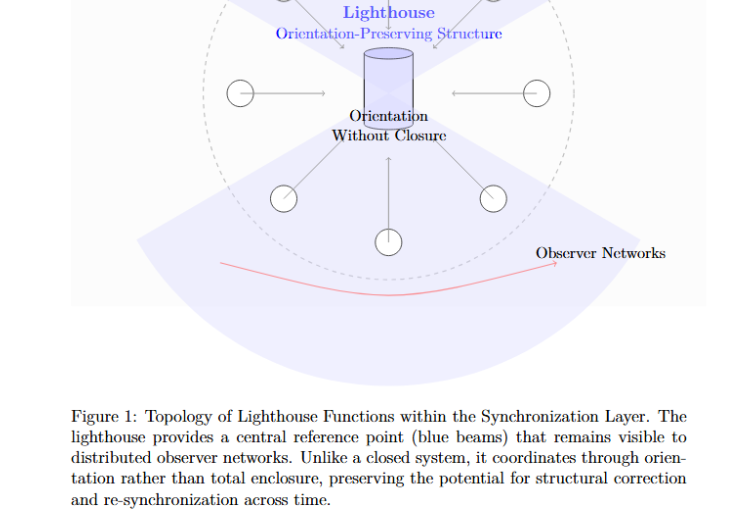
The paper further develops non-closure as a governance principle. A viable civilization is not one that eliminates uncertainty through total closure, but one that remains open to correction, re-entry, and structural revision while sustaining durable continuity. In this sense, civilization-scale design requires not only efficiency and synchronization, but also lighthouse functions: orientation-preserving structures that make distributed correction possible without imposing final closure.
This paper is the eighth in the Selection Geometry / Intent Physics sequence. Paper VI asked how reality formation becomes lived. Paper VII asked how lived realities remain shareable. Paper VIII asks how shared reality becomes durable civilization through ordered, revisable, and accountable sequencing.