
Research Framework
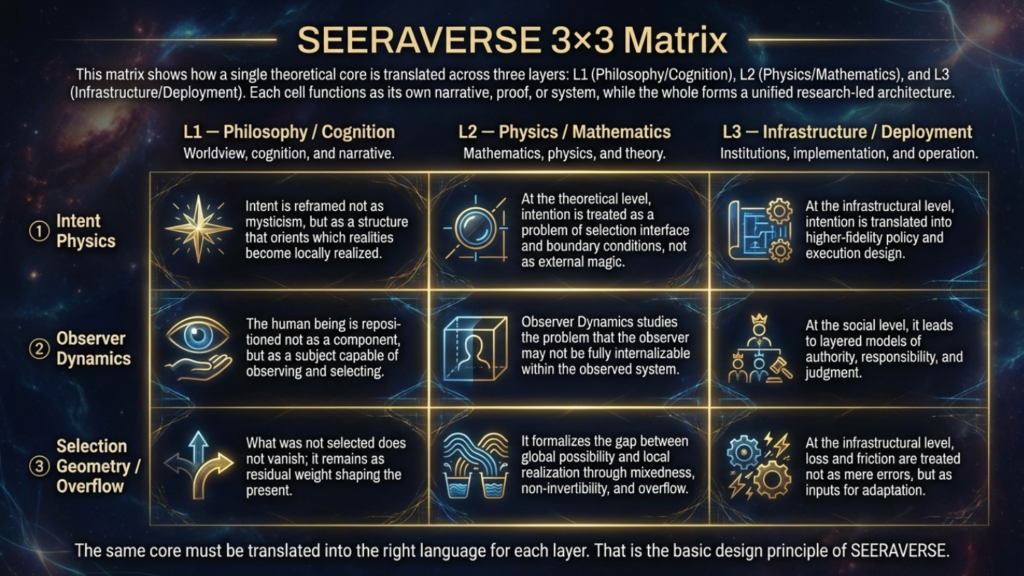
The SRI research framework is a systematic methodology designed to transform ambitious visions into concrete conclusions through a step-by-step process of questioning, evidence gathering, modeling, prototyping, evaluation, and social implementation. Even when working across multiple domains, we prioritize maintaining clarity on what has been confirmed, what remains an inference, and what is still an unverified hypothesis.
Why a Framework is Necessary
AI can connect vast amounts of information in a short time. However, generating a plausible explanation is not the same as establishing truth. Furthermore, optimizing for a single metric can lead to the loss of unmeasured values or minority perspectives.
To move forward while avoiding premature conclusions, SRI separates the process from observation to publication, placing specific checkpoints at each stage.
The Six Research Stages
1. Observation
We collect phenomena, papers, statistics, legal frameworks, news, stakeholder experiences, and system logs. We record sources, acquisition dates, scope, missing data, and observation conditions, distinguishing between the existence of information and its accuracy.
2. Representation
Information is converted into formats suitable for the inquiry—such as text, mathematical formulas, diagrams, data structures, maps, or simulations. Every representation highlights certain aspects of reality while omitting others; therefore, we do not rely on a single diagram or metric to represent the whole.
3. Selection
We explicitly define which hypotheses, variables, boundaries, time scales, and evaluation criteria are adopted. We also record rejected alternatives and the reasons for their exclusion, ensuring that subsequent observers can re-evaluate the decisions.
4. Experiment | Prototyping and Verification
We begin with small-scale calculations, counter-example testing, prototypes, and comparative experiments. AI-generated outputs are treated as candidates for verification, not as evidence themselves. We verify both reproduction conditions and failure modes.
5. Governance | Safety and Responsibility
We design who makes decisions, who is affected, and who has the authority to halt processes. In high-stakes domains such as medicine, law, public policy, and finance, we operate on the premise of expert verification, access control, audit logs, and usage restrictions.
6. Publication | Disclosure and Updates
Findings are translated into research notes, preprints, implementation documentation, and public explanations. Even after publication, we manage versions, corrections, retractions, and reasons for updates to ensure conclusions are never treated as static.
Distinguishing Four Types of Statements
| Fact | Primary sources, observations, and verifiable data. |
|---|---|
| Inference | Interpretations derived from facts; alternative interpretations may exist. |
| Hypothesis | Subjects for future verification; unconfirmed at this stage. |
| Creation | Narratives, metaphors, or future visions used to explore possibilities. |
Non-closure | Designing Against Premature Closure
Rather than indefinitely suspending judgment, we maintain provisional conclusions alongside the room for re-evaluation. By preserving rejected options, minority opinions, and residuals outside the model, we ensure that we can return to these points when circumstances change.
Translation into Implementation
Research outcomes are translated into knowledge databases, decision support systems, AI agents, educational materials, public data visualizations, and auditable workflows. Our core principle is that the convenience of implementation must never be used as a reason to obscure uncertainty or social risks.