
幾何学的オーバーフローから不可逆性が生まれるという仮説
全体状態が可逆的に保たれていても、観測者がアクセスできる局所領域への縮約が非可逆なら、時間順序、混合性、エントロピー増大のような現象が現れ得ると考えます。選択によって失われるアクセス可能性を不可逆性の源として記述する試みです。
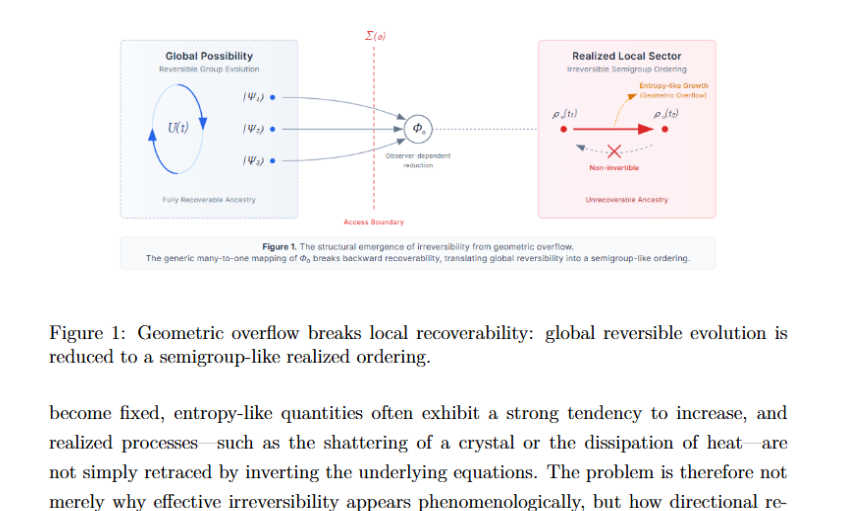
日本語解説
全体状態が可逆的に保たれていても、観測者がアクセスできる局所領域への縮約が非可逆なら、時間順序、混合性、エントロピー増大のような現象が現れ得ると考えます。選択によって失われるアクセス可能性を不可逆性の源として記述する試みです。
この研究の位置づけ
熱力学や量子測定問題の標準理論を証明・置換したものではなく、数理的な検証を進めるための構造提案です。
原題: Geometric Overflow: The Emergence of Irreversibility
English Original / 英語原文
Files https://doi.org/10.5281/zenodo.19010664
Authors/Creators
Description
In the preceding toy formulation of Selection Geometry, local reduced mixedness
was introduced as a first quantitative proxy for geometric overflow: the structural
excess that remains inaccessible under observer-dependent realization.
In this paper, we argue that such overflow provides a natural route to the emergence of irreversibility.
While the global state evolves unitarily and remains fully coherent,
the realized local sector is obtained only through observer-dependent reduction,
and this reduction is generically non-invertible.
As a consequence, realized evolution is not most naturally described by a reversible group structure, but by a
semigroup-like ordering of accessible states. We propose that this structural asymmetry
underlies the appearance of local mixedness, loss of reversibility, entropy-like
growth, and thermality-like behavior without requiring any fundamental breakdown
of global quantum evolution or the ad hoc introduction of stochastic collapse mechanisms.
On this view, irreversibility is neither imposed by external coarse-graining
nor merely an epistemic artifact of human ignorance, but emerges from geometric
overflow itself: what cannot be locally re-accessed reappears operationally as directional
temporal order.
Geometric overflow is thereby advanced as a structural
bridge between reversible quantum possibility and irreversible realized history.