
選択幾何学の最初の数理トイモデル
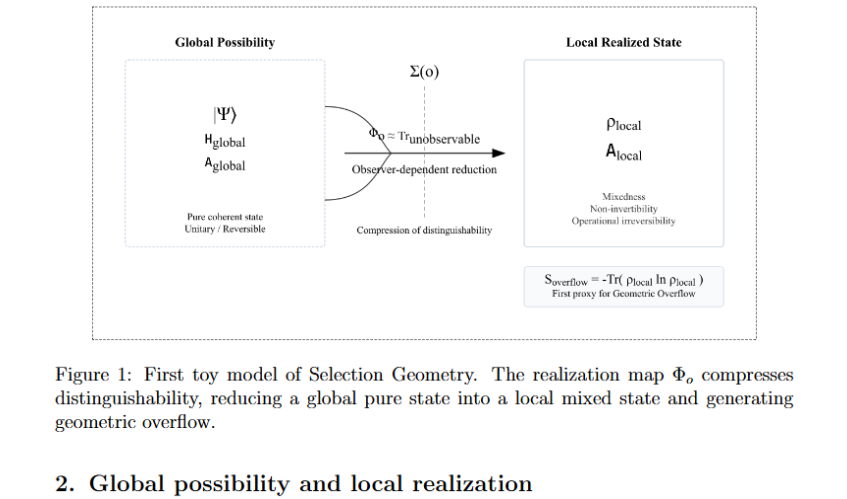
射影ヒルベルト空間上の状態と、アクセス可能性を制限する非可逆な選択写像を用いて、選択幾何学を最小構成で表現します。局所的な混合性を、全体構造が消滅した結果ではなく、観測領域から回収できない構造の指標として扱います。
日本語解説
射影ヒルベルト空間上の状態と、アクセス可能性を制限する非可逆な選択写像を用いて、選択幾何学を最小構成で表現します。局所的な混合性を、全体構造が消滅した結果ではなく、観測領域から回収できない構造の指標として扱います。
この研究の位置づけ
トイモデルは概念の整合性を調べる簡略モデルです。現実の物理系を直接説明・予測する完成モデルではありません。
原題: Selection Geometry: A First Mathematical Toy Model
English Original / 英語原文
Files https://doi.org/10.5281/zenodo.18920800
Authors/Creators
Description
This note develops a first mathematical toy implementation of Selection Geometry.
Selection Geometry proposes that observed physical reality is not exhausted by globally unitary dynamics alone, but arises through observer-dependent realization acting on a larger coherent possibility structure.
In this framework, physical states are represented on projective Hilbert space, while realized history appears through a non-invertible selection map that restricts accessibility and compresses distinguishability. The resulting realized sector is spectrally non-closed: globally coherent structure is not destroyed, but is no longer fully accessible within the local realized description.
This geometric non-closure provides a unified structural perspective on irreversibility, entropy increase, thermality-like behavior, and horizon phenomena. In particular, horizons are interpreted as selection surfaces at which accessibility changes and globally distinct spectral degrees of freedom become locally compressed. Global evolution remains unitary and reversible, whereas realized evolution becomes effectively irreversible due to the geometry of accessibility reduction.
The purpose of this paper is foundational rather than exhaustive. It introduces the core geometric principle, defines the distinction between global possibility and realized history, and clarifies how selection surfaces and spectral non-closure provide a common language for the arrow of time, thermal structure, and horizon-associated radiation. The work does not yet offer a complete dynamical implementation of selection, but establishes the conceptual and geometric basis on which later mathematical toy models and further physical developments can be constructed.