
Residual Structure and the Dark Sector from Geometric Overflow
Files https://doi.org/10.5281/zenodo.19039469
Authors/Creators
Description
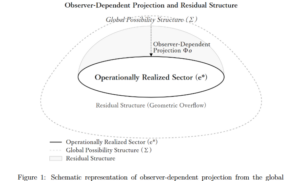
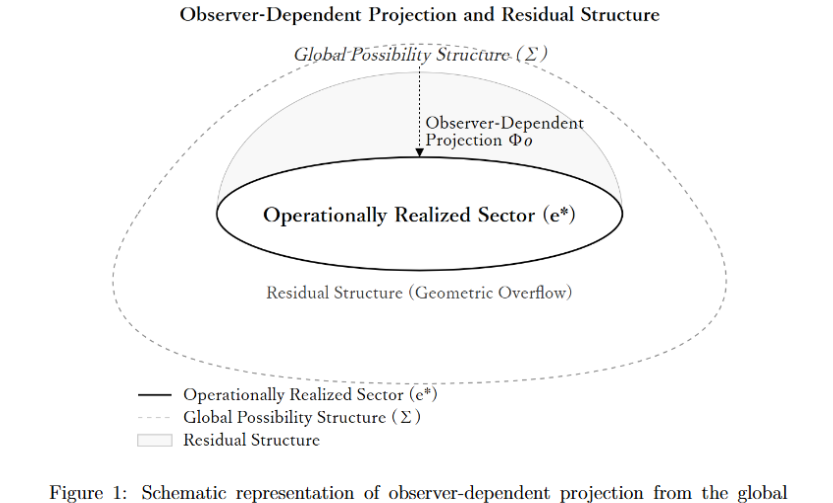
In earlier developments of Selection Geometry, geometric overflow was identified as the part of structure that remains inaccessible under observer-dependent realization. In previous papers, this overflow was proposed as a structural source of irreversibility in the temporal domain and of effective metric structure in the spatial domain.
In the present paper, we extend that line of thought to the largest observable scales and examine its possible cosmological implications. The central proposal is that structure not recovered within the local realized sector may persist as a cosmological residue: a structural remainder that continues to exert effective influence without being localized as ordinary baryonic matter.
On this view, dark-matter-like behavior may be reinterpreted as the gravitational effect of the organization of residual structure that is not absorbed into local realization. Likewise, dark-energy-like behavior may be understood as an effective expansive tendency associated with the persistent non-closure of the realized sector relative to the larger envelope of possibility.
This paper does not claim a complete derivation of cosmological parameters, nor a replacement of the standard ΛCDM model. Its aim is narrower: to establish a structural route by which the dark sector may be read not as a collection of unknown substances, but as the large-scale manifestation of unrealized residual structure.
In this sense, geometric overflow is developed here as a bridge from foundational information constraints to cosmological organization.