
Selection Geometry: A First Mathematical Toy Model
Files https://doi.org/10.5281/zenodo.18920800
Authors/Creators
Description
This note develops a first mathematical toy implementation of Selection Geometry.
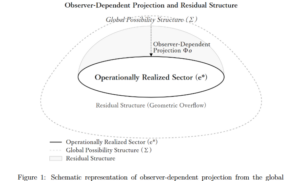
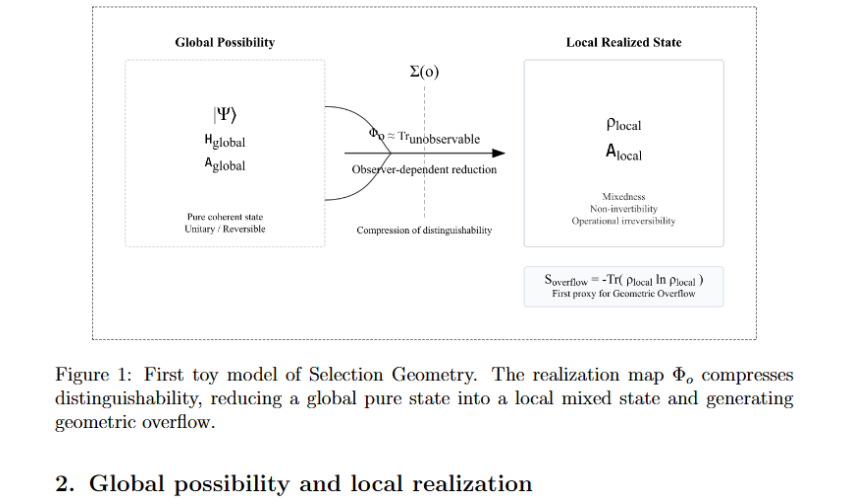
Selection Geometry proposes that observed physical reality is not exhausted by globally unitary dynamics alone, but arises through observer-dependent realization acting on a larger coherent possibility structure.
In this framework, physical states are represented on projective Hilbert space, while realized history appears through a non-invertible selection map that restricts accessibility and compresses distinguishability. The resulting realized sector is spectrally non-closed: globally coherent structure is not destroyed, but is no longer fully accessible within the local realized description.
This geometric non-closure provides a unified structural perspective on irreversibility, entropy increase, thermality-like behavior, and horizon phenomena. In particular, horizons are interpreted as selection surfaces at which accessibility changes and globally distinct spectral degrees of freedom become locally compressed. Global evolution remains unitary and reversible, whereas realized evolution becomes effectively irreversible due to the geometry of accessibility reduction.
The purpose of this paper is foundational rather than exhaustive. It introduces the core geometric principle, defines the distinction between global possibility and realized history, and clarifies how selection surfaces and spectral non-closure provide a common language for the arrow of time, thermal structure, and horizon-associated radiation. The work does not yet offer a complete dynamical implementation of selection, but establishes the conceptual and geometric basis on which later mathematical toy models and further physical developments can be constructed.