
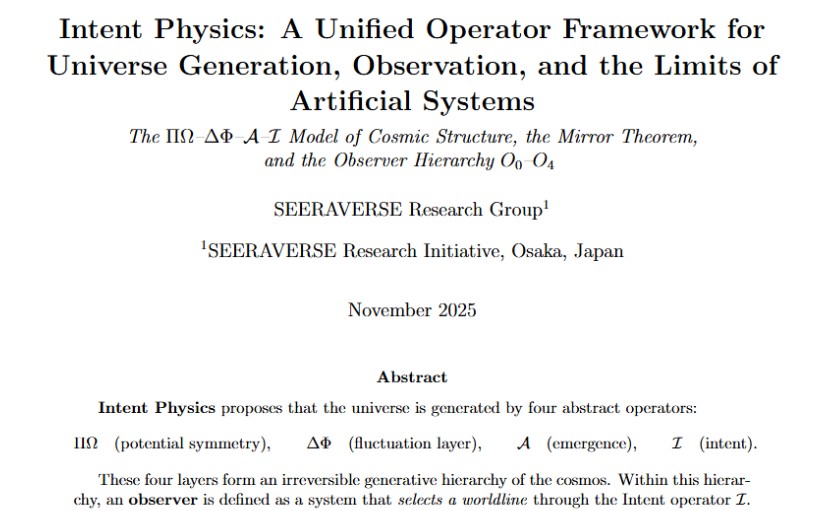
Intent Physics: A Unified Operator Framework for Universe Generation, Observation, and the Limits of Artificial Systems
Files https://doi.org/10.5281/zenodo.17902828
Authors/Creators
Description
Intent Physics is a theoretical framework proposing that the universe is generated by four abstract operators: ΠΩ (potential symmetry), ΔΦ (fluctuation layer), A (emergence), and Ι (intent). These four layers form an irreversible generative hierarchy of the cosmos. Within this hierarchy, an observer is defined as a system that selects a worldline through the Intent operator Ι.
Modern artificial systems, including state-of-the-art large language models, do not instantiate this Intent operator. They cannot originate intent, select futures, or assign meaning in the physical sense. This leads to the central formal statement of the paper, the Mirror Theorem, which argues that AGI/ASI is in principle impossible: artificial systems remain confined to a mirror-mapping layer of input-to-output simulation.
Building on this operator framework, the paper introduces:
- UniverseOS — a generative model of the universe based on the four operators ΠΩ, ΔΦ, A, and Ι,
- the Mirror Theorem — a proof-like argument establishing the impossibility of true AGI,
- the Observer Hierarchy O₀–O₄,
- Intent Physics — a unified framework for life, mind, and creativity,
- cross-domain implications for mathematics, physics, and computation.
The results are presented in a descriptive and non-operational manner. Intent is proposed as the fundamental source of irreversibility, agency, and creativity in the universe. Any artificial system lacking the Intent operator is therefore confined to safe, non-agentic operation within a mirror-like simulation layer. This offers a new perspective on AI safety, the limits of artificial systems, and the deep connection between cosmology, quantum mechanics, observer-dependent physics, the origin of life and mind, and mathematical insight.