
Observer Dynamics: Why Quantum Theory Cannot Internalize the Observer
Files https://doi.org/10.5281/zenodo.18091168
Authors/Creators
Description
Quantum theory provides a complete dynamical description of physical systems, specifying the space of admissible effects and their relations. Yet every empirical application of the theory presupposes that a single outcome is realized. Whether this realization can be internalized within the dynamical framework of quantum theory remains an unresolved foundational question.
In this work, we analyze quantum theory strictly from the inside, including its field-theoretic and particle-physical formulations. We show that quantum theory defines a closed dynamical structure on a space EEE of admissible effects, but does not contain a principle for selecting a realized outcome. Attempts to internalize observation as a dynamical process are shown to exhibit an unavoidable circularity: the mechanisms introduced to explain outcome realization implicitly presuppose the definiteness they aim to account for.
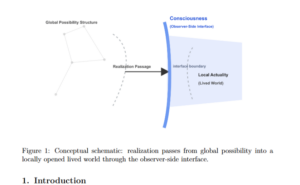
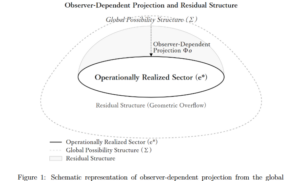
To make this limitation explicit, we introduce the selection map I:E→e\*I : E \rightarrow e^\*I:E→e\*, representing the transition from admissibility to realization. We define the observer as a post-dynamical reference associated with this map, rather than as a physical subsystem or process. We prove a no-go result showing that outcome selection cannot be internalized within quantum dynamics without circularity, even when quantum field theory and fundamental particles are fully taken into account.
We further derive implications for artificial systems by characterizing artificial intelligence as computable transformations on EEE. This leads to the Mirror Theorem: artificial systems can model and manipulate admissible effects but cannot instantiate outcome selection, regardless of their implementation on classical or quantum hardware.
These results establish Observer Dynamics as a boundary principle of quantum theory, delineating what the theory can describe and what it cannot internalize. The observer emerges not as a missing physical mechanism, but as a structurally irreducible post-dynamical reference required for empirical realization.